
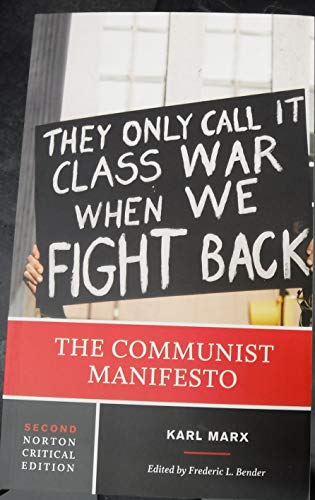
The communist manifesto Karl Marx edited by Frederic L. Bender
Material type: TextPublication details: New York W. W. Norton & Company 2013Edition: 2nd edISBN:
 - 9780393935608
- 335.422/MAR/C
| Item type | Current library | Collection | Call number | Status | Date due | Barcode | |
|---|---|---|---|---|---|---|---|
 Books
Books
|
Park Circus Campus Park Circus Campus | English | 335.422/MAR/C (Browse shelf(Opens below)) | Available | 109987 | ||
|
Books
|
Park Circus Campus Park Circus Campus | 335.422/MAR/C (Browse shelf(Opens below)) | Available | 35006 |
Browsing Park Circus Campus shelves, Shelving location: Park Circus Campus, Collection: English Close shelf browser (Hides shelf browser)

|
|

|

|

|

|

|
||
| 335.4/ WOR/M Marx and Marxism | 335.4/WOR/M Marx and Marxism | 335.412/ PIL/M Marxist political economy essays in retrieval : selected works of Geoff Pilling | 335.422/MAR/C The communist manifesto | 335.95409 /SHA/A Shaping India Economic Change in Historical Perspective | 336.4109 /ROX/R Representing Public credit credible commitment, fiction, and the rise of the financial subject | 337/NAT/I International trade and global civil society |
Karl Marx’s 1848 text is reframed in this revised Norton Critical Edition in the context of twenty-first-century theoretical debates, capitalist globalization, the information technology revolution, and contemporary struggles up to and including the 2011 “Arab Spring.”
Simultaneously extolled in its day as truth incarnate and the inspiration for a life-and-death struggle for humankind’s liberation and condemned as the vilest of propaganda on behalf of despotism, the Communist Manifesto continues to be the most potent literary symbol of the struggle over the form and content of freedom.
This revised Norton Critical Edition provides students with the best documentation and scholarship with which to appreciate the Communist Manifesto’s complexities, context, and legacy of controversy. The Second Edition interprets the Manifesto in relation to the dominance of globalized financial capital, socialist feminist critique, postmodernism, and the fragmentation/transformation of the global working class in the twenty-first century.
The volume includes a carefully annotated text of the Communist Manifesto, the editor’s historical and philosophical introduction, and a chronology of historical events surrounding publication of the Manifesto. Fifteen seminal interpretations—eight of them new to the Second Edition—have been collected. New contributions include Lucien Laurat on the Manifesto’s sociological standpoint as adapted to the modernization of the mid-twentieth century; Wendy Lynne Lee’s assessment of the Manifesto’s key concepts, metaphors, and arguments from a radical-feminist perspective; the article that served as the basis for Empire, Michael Hardt and Antonio Negri’s important postmodernist adaptation of the Manifesto for twenty-first century conditions; and noteworthy responses to Hardt and Negri’s arguments by Slavoj Zizek and by Taki Fotopoulos and Alexandros Gezerlis.
A Selected Bibliography and Index are also included.
There are no comments on this title.